
Bridging the Digital Divide: How ICT Expansion Shapes Secondary Enrollment and Gender Equity in Education
DOI:
https://doi.org/10.63718/dcer.v1i2.12Keywords:
Information and Communication Technologies (ICT), Secondary Education, Gender Parity, Developing Economies, Digital DivideAbstract
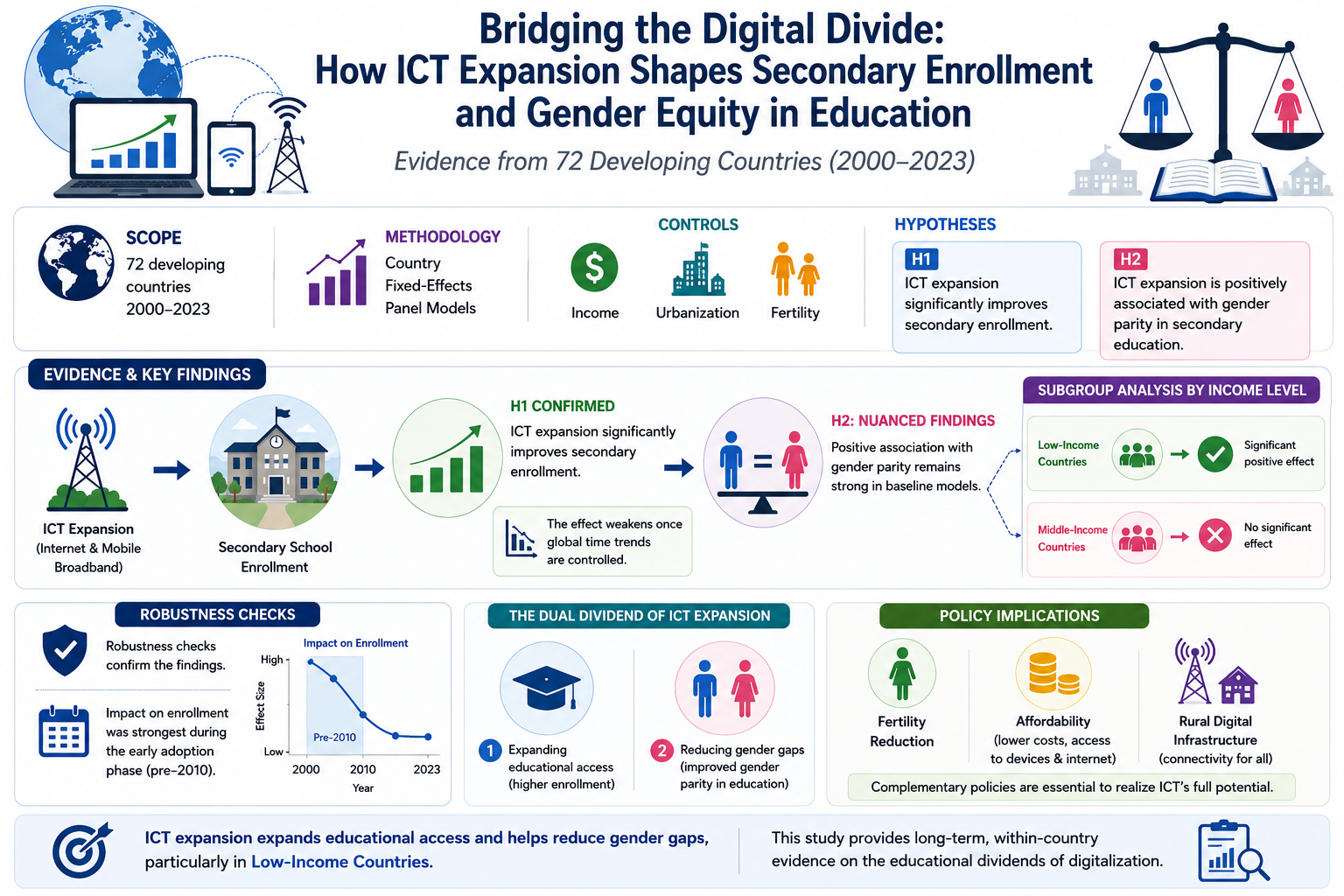
This study investigates the role of information and communication technologies (ICTs) in shaping secondary school enrollment and gender equity across 72 developing countries from 2000 to 2023. Using fixed-effects panel models with controls for income, urbanization, and fertility, the analysis tests two hypotheses: (H1) ICT expansion increases secondary enrollment; and (H2) ICT expansion enhances gender parity in secondary education. The findings confirm H1, showing that ICT expansion significantly improves enrollment rates, though the effect weakens once global time trends are controlled. The evidence for H2 is more nuanced: while the positive association with gender parity remains strong in baseline specifications , a sub group analysis by income level reveals that this equity-enhancing effect is statistically significant only for Low-Income Countries, becoming insignificant for Middle-Income Countries. Robustness checks also reveal that digitalization’s impact on enrollment was strongest during the early adoption phase (pre-2010). The results highlight ICT's dual dividend: (1) expanding educational access and (2) reducing gender gaps yet also underscore the need for complementary policies addressing fertility, affordability, and rural digital infrastructure. The study contributes to debates on ICT for development by offering long-term, within-country evidence on the educational dividends of digitalization.
Downloads
Published
Issue
Section
License
Copyright (c) 2025 Syed Laulak Haider, Saif Ullah (Author)

This work is licensed under a Creative Commons Attribution-NonCommercial 4.0 International License.