
Sustainable Digital Education: Green Literacy and Eco-Critical Practices in Technology-Enhanced Learning
DOI:
https://doi.org/10.63718/dcer.v1i2.13Keywords:
Sustainable Digital Education, Green Literacy, Eco-Critical Pedagogy, Digital Ecological Footprint, Institutional Support, Education Policy, PakistanAbstract
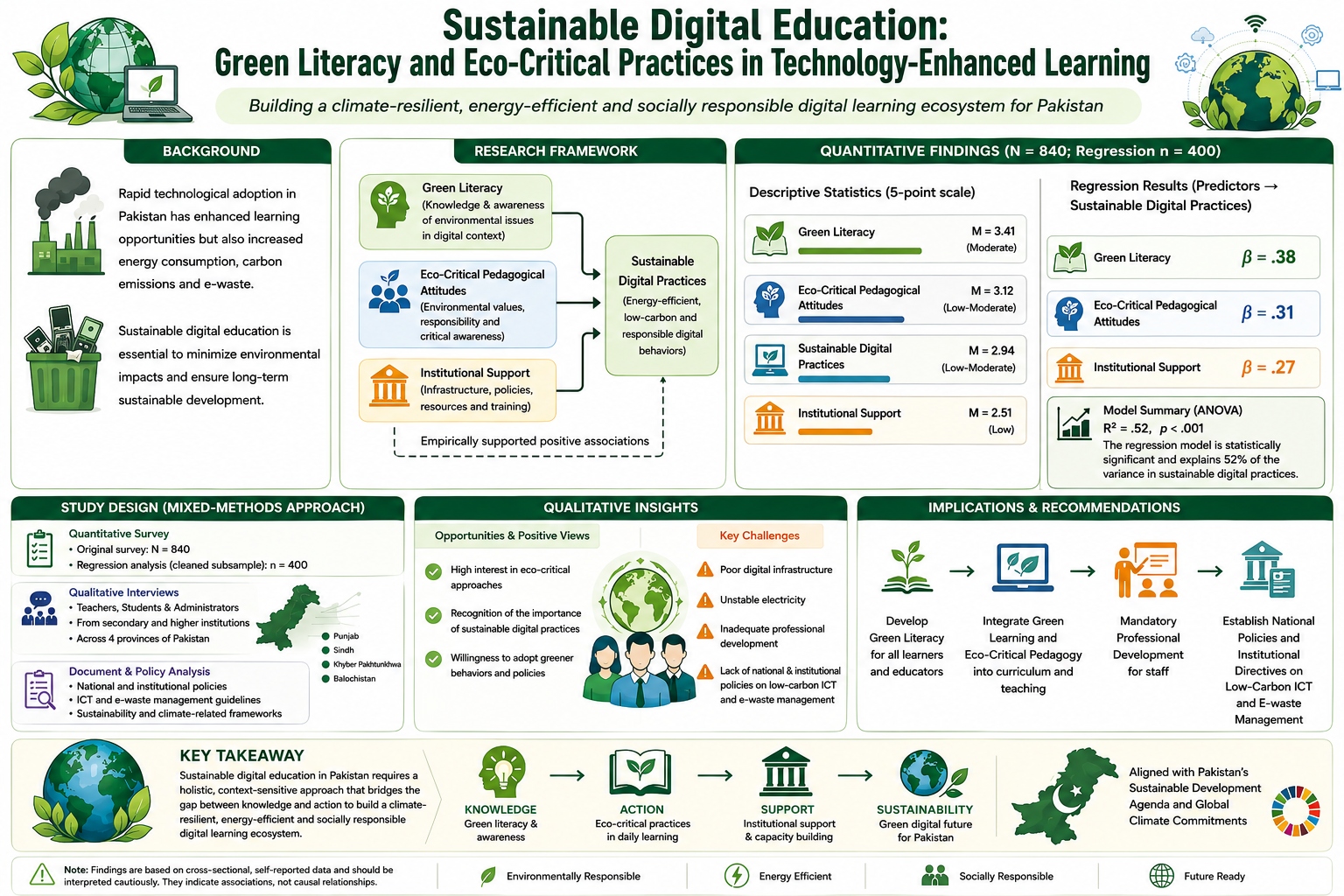
Environmental vulnerabilities have been brought about by global technological adoption and improvement, particularly for emerging nations like Pakistan. Sustainable digital education plays a critical role in reducing the negative environmental effects of the fast growing technology. This research study investigates the significance of green literacy, eco-critical pedagogy, and institutional support in realizing sustainable digital practices among learners and educators of secondary and higher educational institutions across the selected four provinces of Pakistan. The quantitative surveys (N=400) showed moderate green literacy (M=3.41) and significantly lower eco-critical attitudes (M=3.12), sustainable digital practices (M=2.94) and institutional support (M=2.51) on a five-point scale. Furthermore, the regression analysis was applied to a cleaned subsample (n=400) and the regression results revealed that green literacy was found to be the strongest predictor of sustainable digital practices (β =.38), followed by eco-critical attitudes (β =.31) and institutional support (β =.27). In addition, the analysis of variance (ANOVA) results highlighted that the model as a whole was statistically significant (p < .001) and accounted for 52% of the variance in sustainable behaviors. Considering the cross-sectional and self-reported nature of the data, these findings should be interpreted cautiously and are not indicative of causal relationships. Furthermore, the qualitative interviews with teachers, students and administrators have indicated much interest in the eco-critical approaches, while poor infrastructure, unstable electricity, inadequate professional development and lack of national and institutional policies related to low-carbon ICT and e-waste management remained significant impediments. Overall, the results highlight systemic gaps within the digital education system in Pakistan at both the institutional and policy levels and the clear disconnect between knowledge and action. The present study suggests a comprehensive, context-sensitive approach to sustainable digital education, grounded in developing green literacy, integrating green learning with educational processes, obligatory staff training, and national policy directives. Implementation of such reforms will result in a transformation of the rapidly emerging digital learning in Pakistan to a climate-resilient, energy-efficient and socially responsible ecosystem that is aligned with Pakistan's development agenda for sustainable development.
Downloads
Published
Issue
Section
License
Copyright (c) 2025 Muhammad Nisar

This work is licensed under a Creative Commons Attribution-NonCommercial 4.0 International License.