
Sustainable AI in Education: Innovations for Equitable and Ethical Learning Futures
DOI:
https://doi.org/10.63718/dcer.v1i2.14Keywords:
Sustainable Artificial Intelligence, Ethical Educational Technologies, Equitable Learning Systems, AI Governance in Russian Education, Inclusive Digital PedagogyAbstract
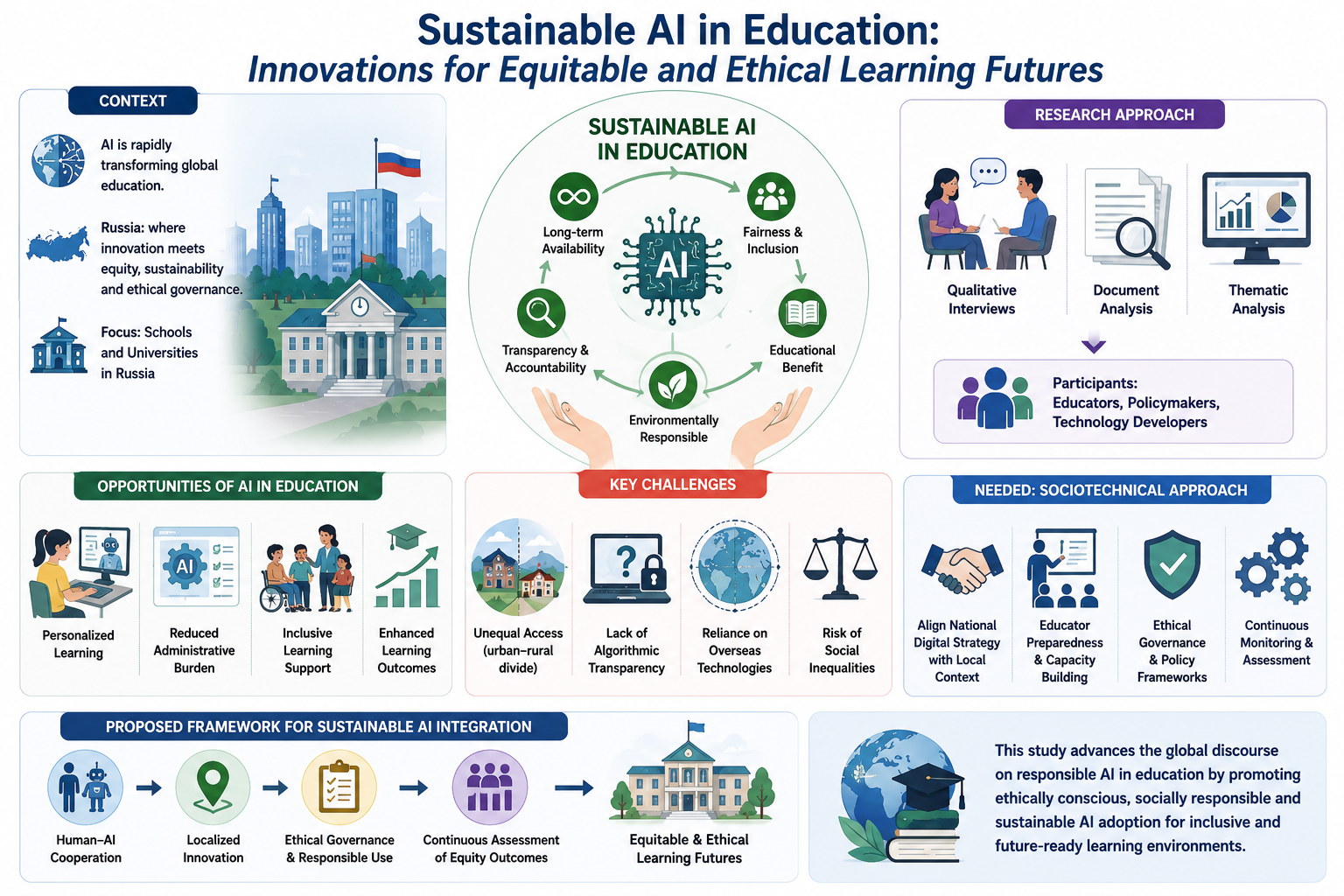
The global education system is reshaped by the fast growing artificial intelligence (AI), Russia has become a significant place where the hopes of technological innovation meet the demands of equity, sustainability, ethical governance. This study examines the conceptualization of sustainable AI and its implementation in Russian schools and universities. Based on the qualitative interviews, document analysis, and thematic analysis, the research examines the interpretations of sustainability in AI-mediated education among educators, policymakers, and technology developers and its implications on educational practices and institutional decisions. The results show that the stakeholders in the existing study understand sustainable AI not only as an environmental friendly technology, but as a system-wide view of sustainable development, which emphasizes long-term availability, fairness, transparency, and educational incentive. This translation corresponds to the known models of sustainable and ethical AI literature (van Wynsberghe, 2021; Rohde et al., 2023; Khan et al., 2025). The participants recognized the opportunities related to the AI implementation, such as increased personalization of learning, fewer administrative tasks, as well as increased support of inclusive learning. Nevertheless, they equally highlighted the persistent challenges including unequal accesses between urban and rural institutions, lack of algorithmic disclosure, reliance on overseas technologies, and the possibility of social inequalities. The study also reveals that the sustainable introduction of AI in Russian educational environment needs a combined sociotechnical approach that would help to synchronize the national strategy of digitalization with the local institutional conditions,, educator preparedness, and the effective system of ethical governance. Based on qualitative findings the study proposes a context-dependent framework of sustainable AI integration based on human-AI cooperation, localized innovation, and constant assessment of equity outcomes. The study contributed to global discourse on responsible AI in education while emphasizes on the essence of ethically conscious and socially responsible AI adoption.
Downloads
Published
Issue
Section
License
Copyright (c) 2025 Sergey Barykin, Murat Akramovich Ikramov and Nilufar Muratovna Nabiyeva

This work is licensed under a Creative Commons Attribution-NonCommercial 4.0 International License.